Will Not The Judge Of All The Earth Do Right? Following Joshua Into The Promised Land

Updated: Aug 11
August 5, 2026
Now the gates of Jericho were securely barred because of the Israelites. No one went out and no one came in.
Then the Lord said to Joshua, “See, I have delivered Jericho into your hands, along with its king and its fighting men. March around the city once with all the armed men. Do this for six days. Have seven priests carry trumpets of rams’ horns in front of the ark. On the seventh day, march around the city seven times, with the priests blowing the trumpets. When you hear them sound a long blast on the trumpets, have the whole army give a loud shout; then the wall of the city will collapse and the army will go up, everyone straight in.”
So Joshua son of Nun called the priests and said to them, “Take up the ark of the covenant of the Lord and have seven priests carry trumpets in front of it.” And he ordered the army, “Advance! March around the city, with an armed guard going ahead of the ark of the Lord.”
When Joshua had spoken to the people, the seven priests carrying the seven trumpets before the Lord went forward, blowing their trumpets, and the ark of the Lord’s covenant followed them. The armed guard marched ahead of the priests who blew the trumpets, and the rear guard followed the ark. All this time the trumpets were sounding. But Joshua had commanded the army, “Do not give a war cry, do not raise your voices, do not say a word until the day I tell you to shout. Then shout!” So, he had the ark of the Lord carried around the city, circling it once. Then the army returned to camp and spent the night there.
Joshua got up early the next morning, and the priests took up the ark of the Lord. The seven priests carrying the seven trumpets went forward, marching before the ark of the Lord and blowing the trumpets. The armed men went ahead of them, and the rear guard followed the ark of the Lord, while the trumpets kept sounding. So, on the second day they marched around the city once and returned to the camp. They did this for six days.
On the seventh day, they got up at daybreak and marched around the city seven times in the same manner, except that on that day they circled the city seven times. The seventh time around, when the priests sounded the trumpet blast, Joshua commanded the army, “Shout! For the Lord has given you the city! The city and all that is in it are to be devoted[a] to the Lord. Only Rahab the prostitute, and all who are with her in her house shall be spared, because she hid the spies we sent. But keep away from the devoted things, so that you will not bring about your own destruction by taking any of them. Otherwise, you will make the camp of Israel liable to destruction and bring trouble on it. All the silver and gold and the articles of bronze and iron are sacred to the Lord and must go into his treasury.”
When the trumpets sounded, the army shouted, and at the sound of the trumpet, when the men gave a loud shout, the wall collapsed; so everyone charged straight in, and they took the city. They devoted the city to the Lord and destroyed with the sword every living thing in it—men and women, young and old, cattle, sheep and donkeys.
-Joshua 6:1-21
*******************************************************************
The Book of Joshua has many extremely difficult passages like this one, moments when Israel fulfills God’s divine mandate given in Deuteronomy 20:16-18:
However, in the cities of the nations the Lord your God is giving you as an inheritance, do not leave alive anything that breathes. Completely destroy them—the Hittites, Amorites, Canaanites, Perizzites, Hivites and Jebusites—as the Lord your God has commanded you. Otherwise, they will teach you to follow all the detestable things they do in worshiping their gods, and you will sin against the Lord your God.
Did every living thing in Jericho have to be destroyed? Was such a slaughter really necessary? Would a loving God not only allow such a thing to happen but demand it?
Many Biblical scholars argue that the language used in the Book of Joshua is typical for military accounts of the time. The victor would state that they had destroyed “every living thing” in a conquered city, but in the case of the Amorites, those living in Jericho, we know this not to be true, as the Bible later speaks of Amorites still living in the land.
But to truly get at the crux of such a troubling passage…”They devoted the city to the Lord and destroyed with the sword every living thing in it – men and women, young and old, cattle, sheep, and donkeys,” we must remember something about God that we have perhaps ignored, replaced, or chosen to forget.
We have become so accustomed to speaking of God's love that we have lost sight of His holiness. Until we recover a proper awe of who God is, passages like this will never make sense, because we will be evaluating them through a diminished view of God rather than the God who reveals Himself in Scripture.
One of the most memorable moments in The Lion, the Witch and the Wardrobe comes before the children ever meet Aslan. Up to this point, they've only heard whispers about him. They know he's powerful, they know he's the true King, but they've never seen him.
Like most of us, they begin filling in the blanks with their own assumptions. Susan wonders if Aslan is a man. When she learns he's a lion, her next question is the natural one: Is he safe? Listen to how Mr. and Mrs. Beaver answer:
“Ooh!” said Susan, “I’d thought he was a man. Is he—quite safe? I shall feel rather nervous about meeting a lion.”
“That you will, dearie, and no mistake,” said Mrs Beaver. “If there’s anyone who can appear before Aslan without their knees knocking, they’re either braver than most or else just silly.”
“Then he isn’t safe?” said Lucy.
“Safe?” said Mr. Beaver; “don’t you hear what Mrs. Beaver tells you? Who said anything about safe? ‘Course he isn’t safe. But he’s good. He’s the King, I tell you.”


We often imagine God as a kind, harmless grandfather whose only role is to make us feel better about ourselves. But Scripture paints a much larger picture. God is infinitely loving, yet infinitely holy. He is merciful, yet perfectly just.
John Bevere argues in The Awe of God that the Church has largely lost the fear of the Lord—not a fear that drives us away from God, but a holy awe that draws us to Him with reverence, humility, and obedience. When we lose our awe of God, we inevitably begin to lower Him to our level. Rather than seeing Him as the holy King of the universe, we begin to think of Him merely as a friend—someone familiar, approachable, and always affirming, but no longer transcendent, majestic, or worthy of trembling worship.
Scripture certainly teaches that, through Christ, we are called friends of God. But friendship with God never diminishes His holiness or His authority. He is still the King. He is still the Judge. He is still the One before whom every knee will bow.
C.S. Lewis, in his book, Mere Christianity, expounded on this idea that God is not safe. He writes:
God is the only comfort; He is also the supreme terror: the thing we most need and the thing we most want to hide from. He is our only possible ally, and we have made ourselves His enemies. Some people talk as if meeting the gaze of absolute goodness would be fun. They need to think again.
In his work, A Greif Observed, Lewis puts it this way:
What do people mean when they say, ‘I am not afraid of God because I know He is good’? Have they never even been to a dentist?
Throughout Scripture, whenever people encounter the living God, their first response is rarely excitement—it is awe. Isaiah cried, "Woe is me!" Simon Peter fell at Jesus' feet and said, "Depart from me, for I am a sinful man." John fell "as though dead" when he saw the glorified Christ.
God's holiness reveals our true condition.
We long for God because only He can satisfy our deepest needs—for forgiveness, purpose, love, justice, and eternal life. Yet at the same time, we instinctively want to hide from Him because His perfect holiness exposes everything in us that is sinful, selfish, and broken.
This has been humanity's response from the very beginning. After Adam and Eve sinned, they didn't run toward God—they hid from Him. They knew they had violated His goodness, and the presence that had once brought joy now brought fear.
This is why Scripture consistently presents God as both Savior and Judge. We often celebrate that God forgives sin, but we are less comfortable acknowledging that He also judges it. Yet if God did not judge sin, He would not be good. A God who ignored evil, overlooked oppression, or dismissed injustice would not be loving—He would be indifferent.
Every one of us longs for justice. We cry out when the innocent are abused, when the vulnerable are exploited, when violence goes unpunished. We rightly want God to judge evil. The difficulty comes when we realize that His standard of justice applies not only to "their" sin but also to ours. God's holiness does not grade on a curve. It exposes every heart equally.
This is not merely an Old Testament theme. Jesus spoke more about judgment than many people realize. He warned of hell, spoke of the coming judgment, described the separation of the righteous from the wicked, and repeatedly called people to repentance because a day of reckoning was coming. The same Jesus who welcomed sinners also declared that every person would one day stand before God and give an account.
Furthermore, grace is not merely a New Testament theme. Jericho was inhabited by the Amorites. In Genesis 15:16, seven hundred years before the fall of Jericho, we read:
In the fourth generation your descendants will come back here, for the sin of the Amorites has not yet reached its full measure.
Nearly seven centuries before Joshua marched around Jericho, God told Abraham that his descendants would not possess the land yet because "the sin of the Amorites has not yet reached its full measure."
In other words, God was not eager to judge the Canaanites. He was patient. Their wickedness had not yet reached the point where His justice required judgment. For hundreds of years, God withheld His hand, giving generation after generation the opportunity to turn from their idolatry, violence, and depravity. But His patience was never intended to eliminate judgment—it delayed it.
Eventually, the sins of the Canaanite nations reached their "full measure," and the God who is perfectly holy and perfectly just acted. The fall of Jericho, therefore, was not an impulsive act of divine anger but the culmination of centuries of divine patience. God allowed Israel to be the instrument of His judgment only after His mercy had been repeatedly extended and persistently rejected.

"The Fall of Jericho" by Gerard van Groeningen (1563-73)
But there was much more to it.
Israel had been chosen not only as an instrument of divine judgment, but as the means through which God’s grace and blessing would reach every nation, including the Canaanites (remember Rahab).
God set Israel apart, gave them the Promised Land, and protected them from those beliefs and practices of other nations that would corrupt and lead Israel away from Him.
Why? For us. For the Canaanites. For the people of every city Israel under Joshua’s leadership defeated. For all of humanity.
I want you to notice what God’s Word tells us at the end of the chapter before the fall of Jericho:
Now when Joshua was near Jericho, he looked up and saw a man standing in front of him with a drawn sword in his hand. Joshua went up to him and asked, “Are you for us or for our enemies?”
“Neither,” he replied, “but as commander of the army of the Lord I have now come.”
Then Joshua fell facedown to the ground in reverence, and asked him, “What message does my Lord have for his servant?”
The commander of the Lord’s army replied, “Take off your sandals, for the place where you are standing is holy.”
And Joshua did so.
-Joshua 5:13-15
Joshua's question seems natural: "Are you for us or for our enemies?" Israel was standing on the edge of battle. The walls of Jericho stood before them, the Promised Land was ahead, and Joshua wanted to know whose side this heavenly warrior was on.
But God's response is both surprising and revealing:
"Neither."
The commander of the Lord's army was not there to take sides in Joshua's battle. He was there to remind Joshua that the greater question was not, "Is God on our side?" but "Are we on God's side?"
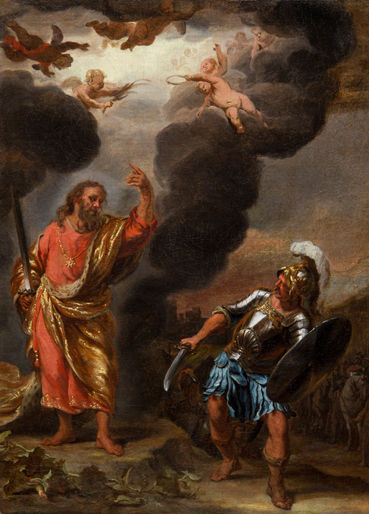
"The Captain of God's Army Appearing to Joshua" by Ferdinand Bol (1660-1663)
We often approach God the same way Joshua initially did. We want God to bless our plans, support our goals, defend our causes, and give victory to our battles. But God does not exist to serve our purposes. He does not come as a reinforcement for our agenda; He calls us to surrender our agenda to His.
This is the difference between treating God as a helper and worshiping Him as King.
Notice what happens next. Joshua does not continue questioning. He does not negotiate. He does not ask for a battle strategy. He falls facedown in reverence. Before God gives Joshua a plan for conquering Jericho, He first reminds Joshua who is truly in command.
Then the commander of the Lord's army says something that sounds familiar:
"Take off your sandals, for the place where you are standing is holy."
These are the same words God spoke to Moses at the burning bush. The message is unmistakable: Joshua is not simply meeting a military advisor; he is standing in the presence of the holy God.
This moment reminds us that God's presence is not something to approach casually. The same God who loves us, leads us, and fights for us is also the holy King before whom we bow.
The commander of the Lord's army did not come to make Joshua's mission easier; He came to remind Joshua that the battle belonged to God. The victory at Jericho would not come because Israel was stronger, smarter, or more strategic. It would come because the holy God was faithful to His promises.
And that truth changes how we view every battle we face. The question is not, "God, are You on my side?" The better question is, "God, am I fully surrendered to Yours?"
God had a much larger plan then Joshua could see. A plan much larger than the Israelites and the Canaanites. What looked like a battle over a city was actually part of God's unfolding plan of redemption for the entire world.
Israel had been chosen to introduce the world to the one true God.
Israel was entrusted with God's Law, revealing humanity's need for a Savior. They were given the sacrificial system and the Passover, both of which pointed forward to Christ's once-for-all sacrifice for sin. They were called to establish the priesthood and build the tabernacle, foreshadowing Jesus Christ, our great High Priest. They were entrusted with the Scriptures and the voices of the prophets, preparing the world for the coming of the Messiah. Centuries before Jesus was born, those prophets proclaimed details of His life, death, and resurrection, providing compelling evidence that He was the promised Messiah. Their story—filled with failures, doubts, and disobedience—became a testimony to the world of God's grace even before the cross, revealing that His promises have never depended on the perfection of His people but on the unwavering faithfulness of His own character.
The walls of Jericho did not fall because God was giving Israel land; they fell because God was moving history toward the moment when He would restore what humanity had lost.
The God who brought down the walls of Jericho is the same God who would later tear down the wall of separation between Himself and humanity through the cross. The same holy God who judged sin is the God who provided His own Son as the sacrifice for sin.
But we still struggle with some of these passages in Joshua, don’t we?
They devoted the city to the Lord and destroyed with the sword every living thing in it—men and women, young and old, cattle, sheep and donkeys.
-Joshua 6:21
I believe at some point we must simply trust, trust that God is perfectly just and perfectly merciful, even when we cannot fully reconcile what we read with what we feel.
Jesus told us in Matthew 10:29-31:
Are not two sparrows sold for a penny? Yet not one of them will fall to the ground outside your Father’s care. And even the very hairs of your head are all numbered. So don’t be afraid; you are worth more than many sparrows.
Genesis 18:25 declares: “Will not the Judge of all the earth do right?”
Psalm 56:8 tells us that God keeps track of people’s tears. God knows every heart, every circumstance, every injustice, and every opportunity a person has been given. His knowledge is perfect, while ours is painfully limited. A person’s years on this earth matter deeply, but the time spent here is not the whole story…there is a much larger plan of redemption going on behind the scenes, a plan that Joshua and the nation of Israel were God’s instrument in helping fulfill.
We see only a moment in history; God sees the beginning from the end.
It is also important to remember that physical death is not God's final judgment. Scripture consistently distinguishes between death in this life and eternal judgment. Every person who died at Jericho ultimately stood—and every one of us will one day stand—before the God who judges with absolute righteousness and complete knowledge. No one will receive more justice than they deserve, nor less mercy than God, in His perfect wisdom, chooses to extend.
Our discomfort with Joshua often comes from assuming that we could judge these events more fairly than God Himself. Yet if God is who Scripture declares Him to be—perfectly holy, perfectly loving, perfectly just, and incapable of wrongdoing—then the safest place for us is not to place ourselves above Him as His judges but beneath Him as His worshipers.
This does not mean we stop asking difficult questions. God is not threatened by honest questions. But there is a difference between questioning God to understand Him and questioning God because we assume our moral judgment is superior to His. Humility reminds us that God is the giver of life and has authority over life and death. There is an infinite difference between the Creator and His creation, between the potter and the clay.
The cross itself proves that God does not simply overlook sin. If sin could have been ignored, there would have been no need for Christ to suffer. At Calvary, we see both the perfect holiness of God and the perfect love of God meeting together. God did not set aside His justice to love us; He satisfied His justice so that He could save us. The judgment that our sin deserved was poured out on Christ, allowing all who trust in Him to receive mercy instead of condemnation.
The good news of the gospel is not that God became less holy or less just. It is that through Christ, sinners can now approach a holy God with confidence. We don't come casually; we come boldly because of Jesus. We don't minimize God's holiness to make ourselves comfortable. We marvel that the holy King who is not safe has made a way for us to draw near because He is infinitely good.



Comments