The Choices We Leave Behind: Following Joshua Into The Promised Land

August 12, 2026
But the Israelites were unfaithful in regard to the devoted things; Achan son of Karmi, the son of Zimri, the son of Zerah, of the tribe of Judah, took some of them. So, the Lord’s anger burned against Israel.
Now Joshua sent men from Jericho to Ai, which is near Beth Aven to the east of Bethel, and told them, “Go up and spy out the region.” So, the men went up and spied out Ai.
When they returned to Joshua, they said, “Not all the army will have to go up against Ai. Send two or three thousand men to take it and do not weary the whole army, for only a few people live there.” So about three thousand went up; but they were routed by the men of Ai, who killed about thirty-six of them. They chased the Israelites from the city gate as far as the stone quarries and struck them down on the slopes. At this the hearts of the people melted in fear and became like water.
Then Joshua tore his clothes and fell facedown to the ground before the ark of the Lord, remaining there till evening. The elders of Israel did the same, and sprinkled dust on their heads. And Joshua said, “Alas, Sovereign Lord, why did you ever bring this people across the Jordan to deliver us into the hands of the Amorites to destroy us? If only we had been content to stay on the other side of the Jordan! Pardon your servant, Lord. What can I say, now that Israel has been routed by its enemies? The Canaanites and the other people of the country will hear about this, and they will surround us and wipe out our name from the earth. What then will you do for your own great name?”
The Lord said to Joshua, “Stand up! What are you doing down on your face? Israel has sinned; they have violated my covenant, which I commanded them to keep. They have taken some of the devoted things; they have stolen, they have lied, they have put them with their own possessions. That is why the Israelites cannot stand against their enemies; they turn their backs and run because they have been made liable to destruction. I will not be with you anymore unless you destroy whatever among you is devoted to destruction.
“Go, consecrate the people. Tell them, ‘Consecrate yourselves in preparation for tomorrow; for this is what the Lord, the God of Israel, says: There are devoted things among you, Israel. You cannot stand against your enemies until you remove them.
-Joshua 7:1-13
******************************************************************
Have you ever had a season when everything seemed to be going right, only to have life suddenly take an unexpected turn?
You get the promotion, and then the marriage begins to struggle.
The church is growing, and then conflict erupts.
The business is thriving, and then momentum suddenly stalls.
That is where Israel finds itself in Joshua 7.
Joshua 6 ends with one of the greatest victories in Israel’s history. The walls of Jericho have fallen. God’s power is on full display. The people are celebrating.
Then chapter 7 opens with one of the saddest words in Scripture: “But…”
"But the Israelites were unfaithful…”
Notice…the Scriptures read, “But the Israelites were unfaithful…”
But the truth is that only one man was unfaithful, only one man sinned…His name was Achan.
Back in chapter 6, God gave Joshua instructions to march around the city for six days and on the seventh day, to march around the city seven times, and when the priests sounded the trumpet blast, have everyone “Shout! For the Lord has given you the city!”
God gives Joshua further instructions in verses 18-19:
But keep away from the devoted things, so that you will not bring about your own destruction by taking any of them. Otherwise, you will make the camp of Israel liable to destruction and bring trouble on it. All the silver and gold and the articles of bronze and iron are sacred to the Lord and must go into his treasury.
Jericho was the first city Israel conquered after entering the Promised Land. God commanded that the city be placed under the ban (Hebrew: herem), meaning it was to be “devoted” or “set apart” entirely for God. Therefore, no Israelite was to profit personally from the conquest and the precious metals collected would be placed in God’s treasury.
The Israelites had not built a permanent Temple and so they worshipped in the Tabernacle, the portable sanctuary God had instructed Moses to construct in the wilderness. The “devoted things,” “all the silver and gold and the articles of bronze and iron,” were to be placed in God’s treasury and used for materials used in the Tabernacle and for worship including lampstands, basins, trumpets, sacrificial instruments, future repair, and maintenance. These treasures were also stored away to be used to build the Temple over four hundred years later.
The materials collected were also used to provide for the ministry of the priests and Levites. The tribe of Levi received no territorial inheritance. They devoted themselves to the teaching of God’s Word and worship. Such resources helped sustain them and their ministry.
So, one man…Achan…decided he would take some of the precious treasures discovered in Jericho for himself.
When confronted by Joshua, he confesses. Achan says:
It is true! I have sinned against the Lord, the God of Israel. This is what I have done: When I saw in the plunder a beautiful robe from Babylonia, two hundred shekels of silver and a bar of gold weighing fifty shekels, I coveted them and took them. They are hidden in the ground inside my tent, with the silver underneath.

Achan's sin runs parallel to Adam and Eve's in the Garden of Eden. His confession follows the same tragic sequence:
"I saw... I coveted... I took... I hid." (Joshua 7:21)
Compare that with Genesis 3:
Eve saw that the fruit was good for food and pleasing to the eye (Genesis 3:6).
She desired (coveted) what God had forbidden, believing it would make her wise.
She took the fruit.
Then Adam and Eve hid themselves from God (Genesis 3:8).
James later describes the same progression:
Each person is tempted when they are dragged away by their own evil desire and enticed. Then, after desire has conceived, it gives birth to sin; and sin, when it is full-grown, gives birth to death. (James 1:14–15)
“But the Israelites were unfaithful…”
But the truth is that only one man was unfaithful, only one man sinned…His name was Achan.
Achan likely thought: “No one saw;” “I buried it;” “It doesn’t hurt anyone.” Yet, because of Achan’s sin, “thirty-six” soldiers were killed and the Israelites were defeated by AI.
Joshua tears his clothes and falls facedown “before the ark of the Lord, remaining there til evening. The elders of Israel did the same, and sprinkled dust on their heads.”
The Lord answered their prayers, informing Joshua that the reason they were defeated was because there was sin in the Israelite camp. God’s covenant had been violated. Some of the “devoted things” had been stolen.
Sin hinders God’s work in our lives. Sin hinders our fellowship with God. What we refuse to confront will eventually control us. It must be confronted, confessed, and removed before we, before God’s people, can move forward.
Furthermore, sin hurts everyone.
Our culture teaches that sin is private, but this is contrary to scripture. The Bible teaches us that we are connected and an individual’s sin has ramifications far beyond the individual.
A driver’s decision to text behind the wheel can take an innocent life and devastate an entire family.
A spouse’s hidden unfaithfulness does not remain between two people; it wounds a marriage, impacts children, and damages generations of trust.
One athlete’s lack of discipline can cost an entire team a championship.
A business owner’s decision to cut corners can harm employees, customers, and the reputation of everyone connected to the company.
One person’s refusal to forgive can keep an entire family trapped in years of bitterness and division.
One person spreading gossip can fracture relationships, divide a church family, and damage years of unity.
Paul echoes this truth in I Corinthians 12:26:
If one part suffers, every part suffers with it; if one part is honored, every part rejoices with it.
Every one of us, through our choices, releases something into the world. Achan released consequences that affected an entire nation, while others have released blessings that have impacted generations. The question is: What are my choices producing in the lives of others? What kind of legacy am I creating—not only today, but years and even generations from now?
Two examples:
First, Captain Ahab in Herman Melville’s Moby-Dick.
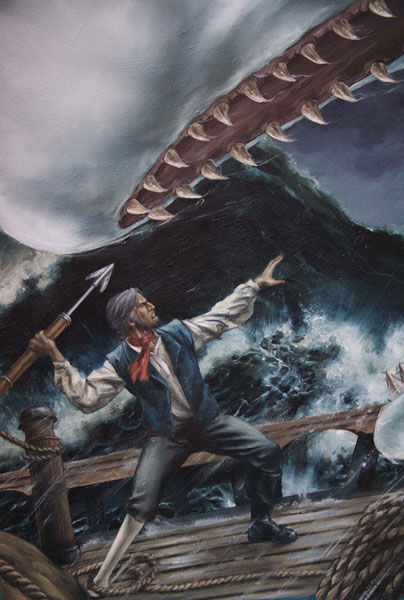
After losing his leg to the great white whale Moby Dick, Captain Ahab becomes consumed by revenge. His sin, obsession, and pride do not just affect him—they lead to his own destruction and ultimately endanger his entire crew. Ahab's personal pursuit of vengeance becomes everyone's burden, as his obsession leads to the destruction of the ship and the death of nearly the entire crew, with only one survivor.
On the other hand, think about George Bailey in the movie, It’s A Wonderful Life.

In the movie, George Bailey is a man who spends his life putting others first. He has dreams of traveling the world, becoming an architect, and building great things. But circumstances repeatedly call him to sacrifice his own plans for the sake of others.
He gives up his dreams to run the family business, the Bailey Building & Loan, because he believes ordinary families deserve an opportunity to own homes and build better lives.
Over the years, George makes countless decisions that seem small:
He helps a struggling family avoid losing their home.
He provides affordable housing for people who otherwise would have been trapped in poverty.
He sacrifices his own opportunities to keep the business serving the community.
He invests in people when others only see profits.
But George doesn't see the impact.
After a crisis causes George to believe his life is worthless, his guardian angel Clarence shows him what his town would have looked like if he had never existed.
George discovers:
The pharmacist he once saved from making a deadly mistake would have ruined his career and gone to prison.
His brother Harry, whom George saved as a child, would never have grown up to become a war hero who saved hundreds of soldiers.
His wife Mary would have lived a lonely life without him.
His community would have been controlled by the selfish and greedy Mr. Potter.
The people George helped would have faced hardship without the opportunities he provided.
The revelation overwhelms him because he finally sees what he could not see: His life mattered and the ordinary choices he made daily, choices he thought were insignificant, had shaped countless lives for the better.
In the 1960’s, meteorologist and mathematician Edward Lorenz realized that a tiny difference, less than one part in a thousand, would produce a completely different weather pattern over time. This became known as the butterfly effect, the idea that a small action can create a ripple that grows far beyond what we can see. A butterfly flapping its wings on one side of the world may seem insignificant, but over time, those small movements can contribute to larger changes. In the same way, our daily choices, words, attitudes, and actions may appear small in the moment, but they are constantly shaping the lives of those around us.
The legacy we leave will not be determined by one great moment, but by the thousands of choices we make every day. We may never know how a kind word encouraged someone, how an act of integrity influenced a child, how a sacrifice changed a family, or how a selfish decision wounded someone who carried that hurt forward. Every choice releases something into the world.
Achan’s story reminds us that our choices are never just about us. We are connected. Every conversation, every decision, every act of courage, and every moment of integrity sends a ripple into the lives around us. The question is not whether we will influence others—the question is what kind of influence we will have.
What am I releasing into the world? What ripple am I creating? And when my story is finished, will the lives of others be better because I was here?



Comments